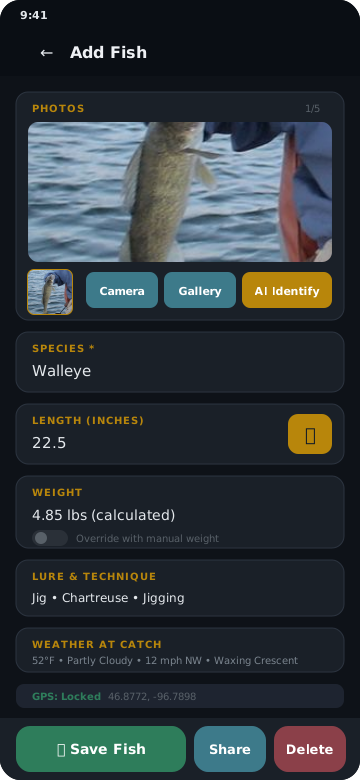
No server round-trip, no signal needed — just snap a photo and know what you caught in about two seconds.
Yes — Elevated Fishing identifies fish entirely on your Android phone. It runs a three-stage neural pipeline (detection, segmentation, and a 639-species classifier) plus five rerankers, with no internet connection required. You get ranked suggestions with honest confidence scores, and you can override the result in one tap.
Most "AI fish ID" apps either need an internet connection (because the model lives on someone's server) or ship a tiny model that mistakes a bluegill for a crappie. Elevated Fishing bundles three real neural networks into the app itself and runs them locally:
A five-stage reranker then layers on context: geographic plausibility from your GPS, common-species priority, freshwater vs. saltwater inference, family aggregation, and confusion-pair hints (largemouth vs. smallmouth, for example). It knows a saltwater grouper shouldn't top the list on a North Dakota lake — and it tells you when a photo isn't clear enough to be sure.

The model is in your pocket, not on a server you have to reach.
Works with zero signal. The remote lakes where you actually fish are exactly where cloud-based ID apps fail. Ours doesn't reach for the internet at all.
Instant. No upload, no waiting on a round-trip. Auto-identify triggers the moment you snap the photo.
Private. Your fish photos never leave your phone. There's no server collecting your catches to train on.
Honest about uncertainty. Calibrated confidence means it asks for a clearer shot instead of confidently guessing wrong.
Yes. The entire identification pipeline runs on your phone, so it works with no internet connection at all. You can fish a remote lake with zero bars and still get a species ID the moment you snap a photo. Nothing is uploaded to a server, because there isn't one.
The on-device classifier covers 639 species. Five rerankers then use your GPS location, water type (fresh vs. salt), and known confusion pairs to refine the result, so a saltwater grouper will not show up as the top pick on a North Dakota lake.
Accuracy varies by species and photo quality, which is why the app shows ranked alternatives with calibrated confidence. When it isn't sure, it tells you and asks for a clearer side-profile shot rather than guessing. The right species is almost always the top pick or one tap away in the alternatives list.
You can override the suggestion with the correct species in one tap. The model does not learn from your correction, because that would require sending data off the device, which the app never does. Your catch is simply recorded correctly.